
As 5G networks accelerate their rollout worldwide, the number of 5G base stations has surged dramatically. By the end of 2023, China alone had built more than 3.3 million 5G base stations, accounting for over 60% of the global total. Within these communication systems, aluminum die cast components play a vital role. Acting as both the “skeleton” and “armor” of 5G devices, they not only protect internal electronic modules but also ensure efficient heat dissipation, lightweight construction, and integrated structural design. Thanks to their outstanding overall performance, aluminum alloy die castings have become indispensable in the manufacturing of modern 5G equipment.
Compared with 4G, a single 5G base station consumes almost three times more power, with individual units exceeding 3,500W. This high power demand generates substantial heat that must be dissipated quickly to guarantee signal stability and extend equipment lifespan. At the same time, the higher density of 5G deployments makes compact size and lightweight structures even more important, particularly in urban areas where installation space is limited.
Aluminum die castings meet these challenges with a combination of superior thermal conductivity, low density, and high strength. By optimizing the design of heat sinks, manufacturers can reduce internal temperatures significantly, even in extreme climates. Advanced aluminum-magnesium alloys, for example, achieve more than 20% better thermal conductivity than traditional ADC12 alloys, boosting overall cooling performance by up to 30%.
Another strength of aluminum die castings lies in their ability to combine lightweight construction with durability. With a density of just 2.7 g/cm³ and high tensile strength, aluminum alloys enable the production of large, thin-walled structures that remain strong and stable. Structural simulations and topology optimization further reduce component weight by more than 15% while enhancing rigidity by 10%.
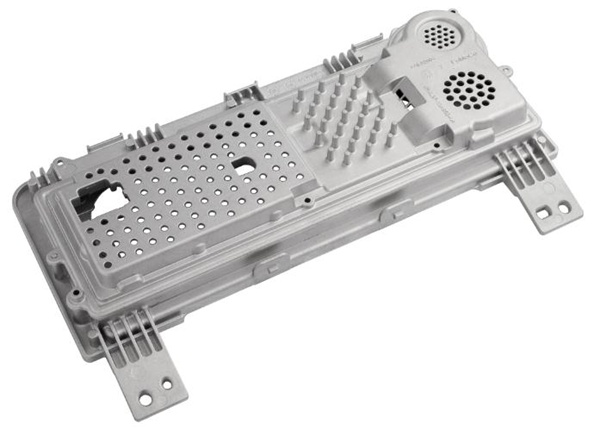
Die casting allows for highly integrated one-piece designs. Heat sinks and housings can be cast as a single unit, minimizing assembly steps and ensuring better sealing and mechanical stability. For example, a leading equipment supplier successfully reduced an AAU housing from 12 separate parts to just one integrated casting, improving assembly efficiency by 50% and achieving IP67-grade sealing performance.
Durability and sustainability are also key advantages. The natural oxide layer formed on aluminum surfaces provides excellent corrosion resistance, allowing die cast parts to withstand harsh outdoor conditions. On top of that, aluminum alloys are highly recyclable, with recovery rates exceeding 95%. Recycled aluminum still meets the majority of production requirements, making it an environmentally friendly choice aligned with circular economy principles.
Innovation in die casting is also transforming how aluminum components are used in 5G devices. Semi-solid die casting, for instance, enhances material density and thermal conductivity by reducing porosity. This technology enables chip housings to operate at temperatures up to 7°C lower than conventional castings, while improving heat distribution uniformity by 20%. Companies such as Runxing Tai and Silver Basis have already applied semi-solid die casting to 5G base station housings and filter cavities, producing lighter, more thermally efficient parts.
Another breakthrough involves the integration of gas-inflated cooling plates with die cast housings, creating hybrid “active + passive” cooling systems. These designs are particularly suited for AAU units that demand higher cooling efficiency, improving heat dissipation by more than 40% compared with traditional fin structures.
The production of large-scale die castings for 5G also depends on advanced machinery and automation. Modern facilities now rely on 1,000T to 4,500T die casting machines combined with mold temperature controllers, vacuum systems, and robotic handling. Precision mold temperature control prevents defects such as shrinkage or deformation, while vacuum die casting reduces internal porosity to less than 0.5%, significantly enhancing both mechanical strength and thermal performance.
Automated inspection systems powered by machine vision further ensure 100% quality control, replacing traditional random sampling and minimizing the risk of defective parts. These technologies together ensure that aluminum die castings meet the demanding requirements of 5G communication equipment.
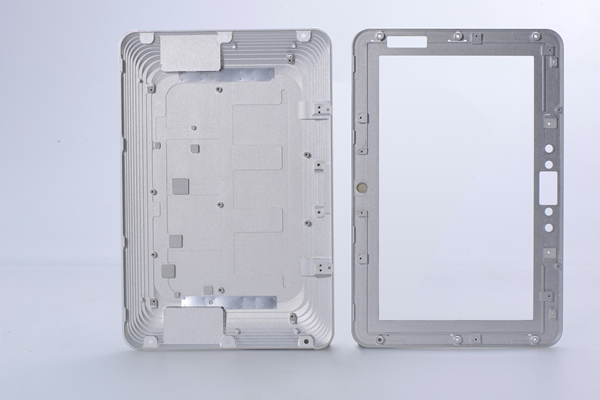
Looking ahead, aluminum die castings will continue to evolve alongside the needs of 5G and the Internet of Things. Next-generation materials, such as nano-reinforced aluminum composites, promise thermal conductivity above 200 W/m·K and strength improvements of more than 30%. Structural innovation is also pushing towards thinner, more complex cooling fins and multi-chambered housings, with hybrid approaches like 3D printing combined with die casting enabling highly customized designs.
Smart manufacturing systems powered by the Industrial Internet of Things are making production more reliable and traceable, with AI-driven process optimization improving consistency to nearly 99.5%. Beyond base stations, aluminum die castings are extending into edge computing devices, automotive 5G modules, and industrial gateways. For example, aluminum housings for in-vehicle 5G T-Boxes not only manage heat but also provide electromagnetic shielding, becoming standard components in smart connected vehicles.
Though often overlooked, aluminum die castings are the silent enablers of 5G. From housings and filter cavities to cooling innovations and intelligent production lines, they form the foundation that supports performance, reliability, and lightweight design in modern communication networks. As materials science and manufacturing technology continue to advance, die cast components will remain essential, paving the way not only for 5G but also for the next leap forward into 6G and integrated space-air-ground networks.
If you are looking for a professional manufacturer of aluminum alloy die castings, EDT Diecasting Technology (Suzhou) Co., Ltd. is the partner you can rely on. With advanced European die casting expertise and over 20 years of experience in the Chinese market, we are dedicated to delivering high-quality die cast components. Our state-of-the-art melting, casting, and testing facilities ensure consistent product quality. Whether you require complex structural parts or precision housings, EDT provides reliable solutions with scientific processes and a commitment to excellence. Choosing EDT means choosing quality and trust.
Hotline
0512-67371602
E-mail:sales@edt-china.cn
Add:West Building, 66 Songshan Road, Suzhou New District, P.R. China

Hotline